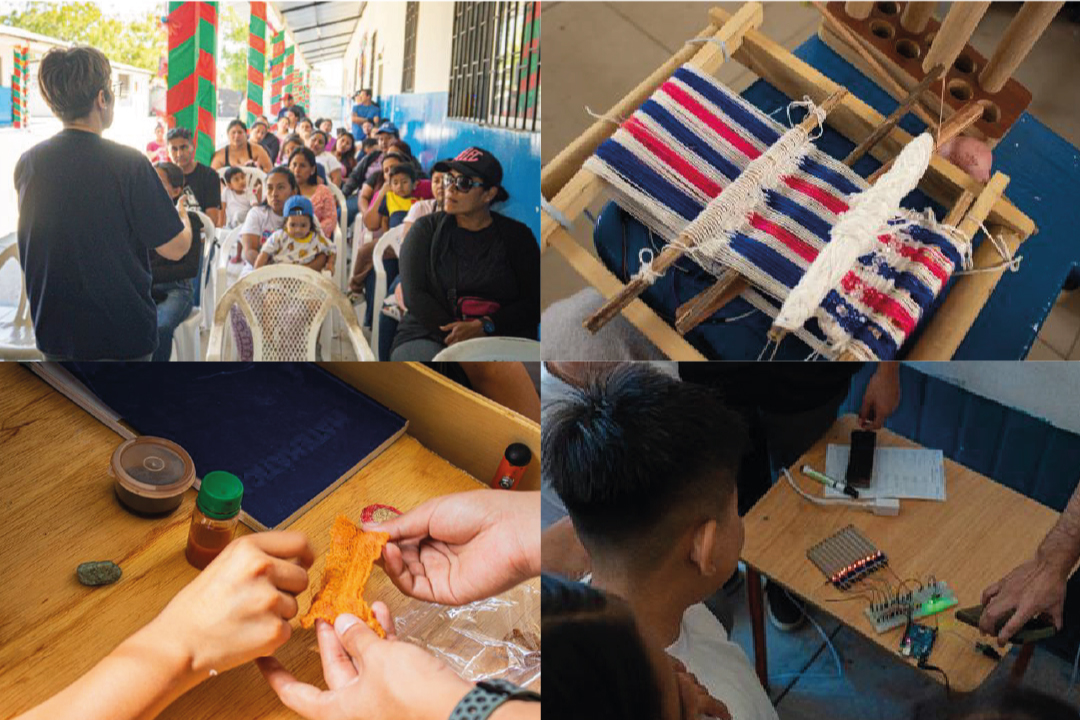


As part of its commitment to social engagement, ESPOL—through FADCOM and in collaboration with various schools—carried out Phase III of the project “Development of Ancestral Knowledge through Community Design and Art (SADA)” during the 2025–2026 period, with the goal of integrating the artisanal heritage of the Santa Elena Peninsula into formal education processes. This initiative was carried out in the communities of Pechiche and Manantial de Chanduy, located in the Chanduy parish, where the team worked directly with the Roberto Alejandro Narváez (RAN) and Mercedes González de Moscoso (MGM) elementary schools.
In total, 92 students in grades 5, 6, and 7 participated, along with teachers, administrators, and families, who became key players in the process. The project addressed a specific issue: the gradual loss of ancestral artisanal knowledge due to a lack of generational succession and its limited incorporation into the school curriculum.
Given this context, the initiative focused on introducing this knowledge from an early age, strengthening students’ cultural identity and critical thinking skills. The methodology implemented combined ethnographic research, co-design, and participatory action research, enabling the development of hands-on, playful workshops and innovative teaching materials that integrate ancestral knowledge—such as textiles, ceramics, metalwork, and toquilla weaving—into subjects like mathematics, natural sciences, social sciences, and art education.
This approach transformed the classroom into a space for active experimentation, where students not only learn curricular content but also reconnect with their environment, history, and cultural identity. Among the key findings, it is noteworthy that 95.5% of students used the teaching materials developed, while 100% of teachers participated in validating the activities, demonstrating a high level of buy-in for the project.
In addition, the project successfully designed and implemented tools such as teaching guides, educational games, mobile apps, short documentaries, and technological prototypes, thereby consolidating an innovative educational approach that integrates traditional and contemporary elements.
© Photography: Courtesy/ Text: José Luis Castro