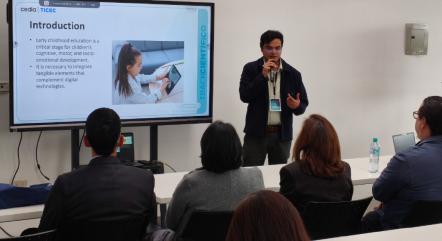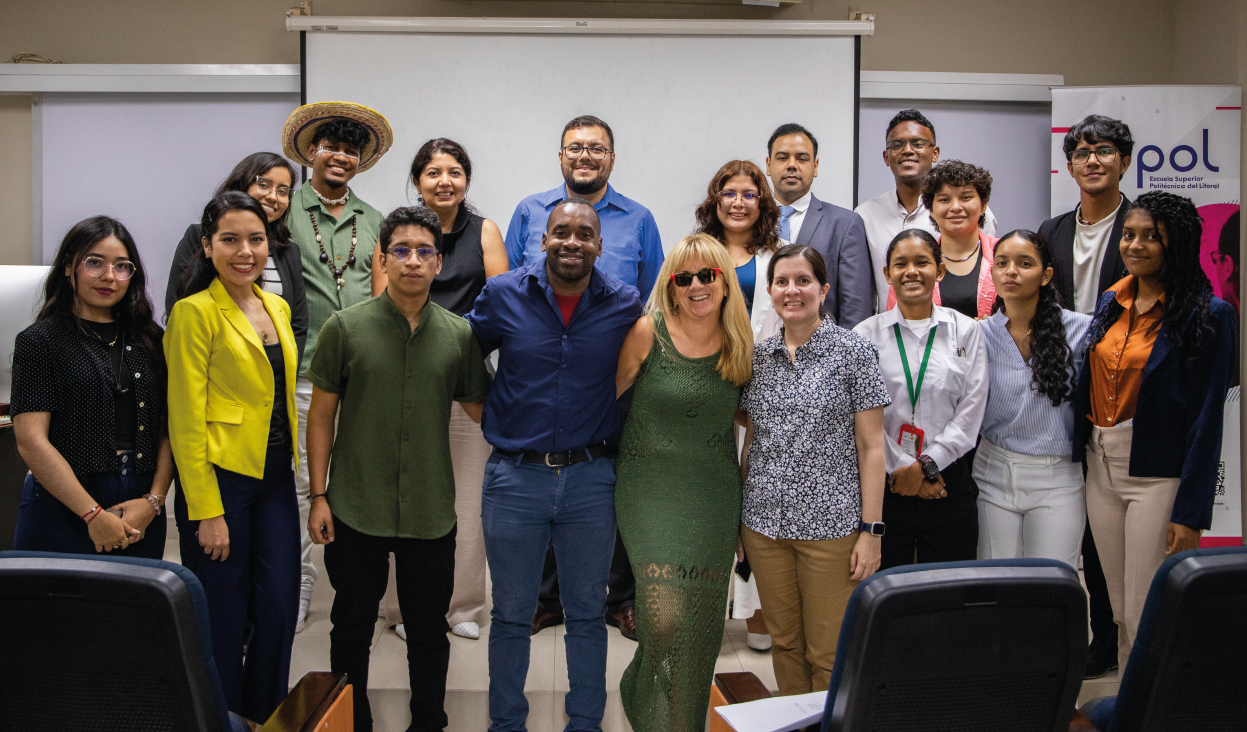


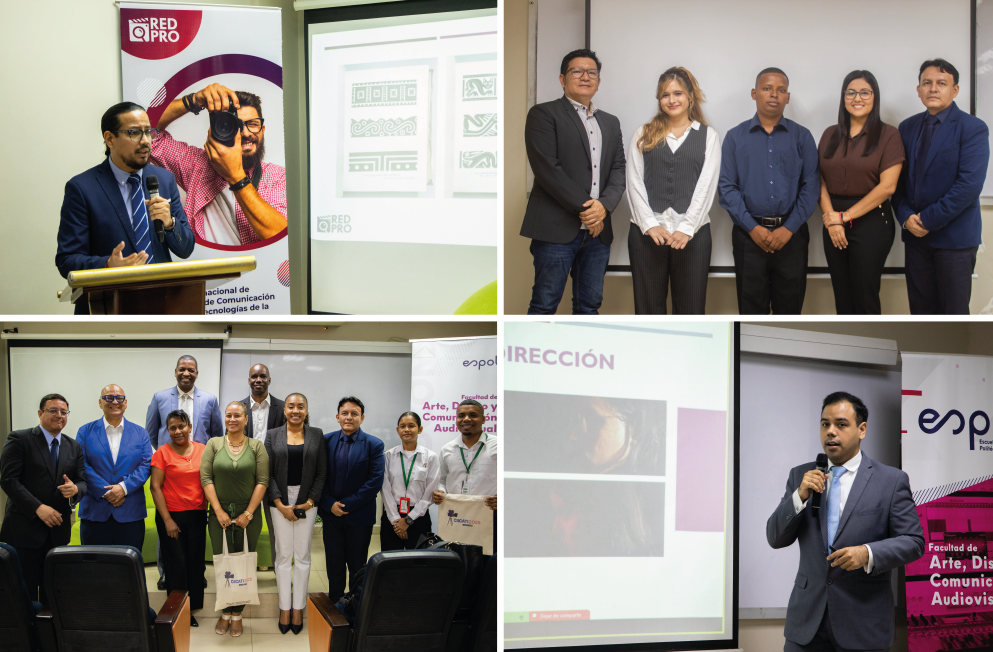
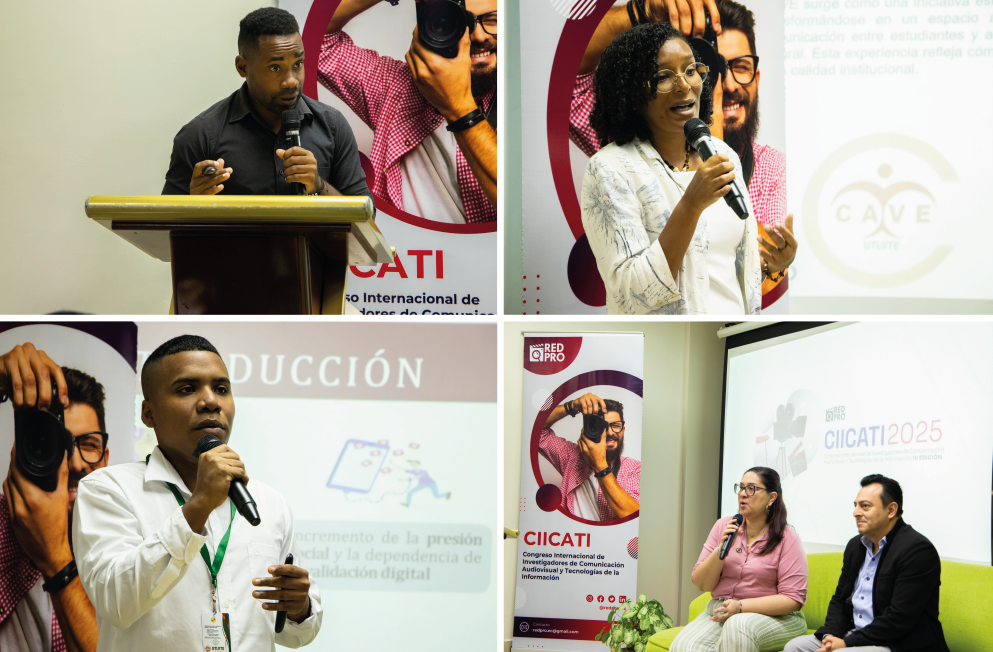
On Thursday, November 6, 2025, the fourth edition of the International Congress of Researchers in Audiovisual Communication and Information Technology (CIICATI 2025) was held in a blended format at FADCOM and broadcast online. The event was co-organized by the Audiovisual Production Research Network (REDPRO) and the Faculty of Art, Design, and Audiovisual Communication (FADCOM–ESPOL), and was attended by more than 120 people in person and more than 200 virtual spectators.
The conference brought together researchers, teachers, and students from 11 universities across the country. From more than fifty applications received, and after a blind peer review process conducted by the scientific committee, 41 papers were selected and presented during the conference. In total, the conference welcomed 72 speakers, including students and academics, who presented their research, strengthening the exchange of knowledge and scientific production in the audiovisual and technological fields.
Student participation and awards
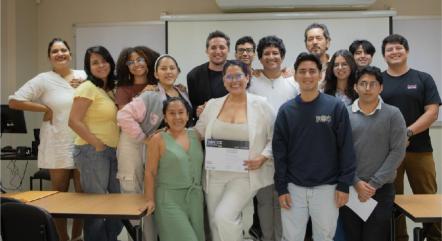
The event stood out for the active participation of young researchers: 14 presentations were given by third-level students and 12 by fourth-level students, demonstrating the growing interest in research within academic training and the Ecuadorian audiovisual field.
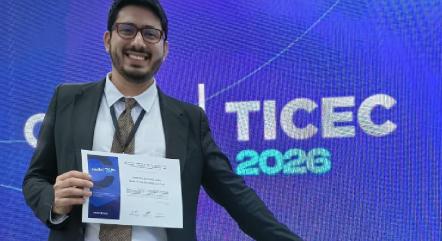
In order to promote student research, the REDPRO scientific committee held a vote to recognize the best works. The award for Best Third-Level Work was given to the presentation “The Digital Mirror of Prejudice: Reflection of Human Data. An analysis of gender and racial biases in AI,” by Luis Quiñónez Urbina, Luis Ayoví Mejía, and Míriam Merchán Morales. In the Fourth Level category, the award went to “The Emerald Voices: Audiovisual Analysis from Scarification to Afro-Indigenous Resistance Body Paintings” by Andrés Caicedo and Arturo Toala. Both works were presented by researchers from the Luis Vargas Torres Technical University of Esmeraldas.
Opening panel: Artificial Intelligence and Young People
The academic conference began with the expert panel “Artificial Intelligence and its Impact on Young People,” composed of Wellington Villota, Ph.D., researcher in AI and education at the Catholic University of Santiago de Guayaquil (UCSG); María del Carmen Rodrigo, MSc., clinical psychologist and EMDR therapist; and Juan Sotomayor, Ph.D., researcher in Computer Science at the University of Florida (UFL). The panel was very well received by attendees, especially during the question and answer session, which reflected on the role of artificial intelligence not only in the lives of young people, but also in politics, ethics, and contemporary society.
Presentation tables: art, communication, and technology
At 10:30 a.m., the Emerging, Interactive Technologies and Social Networks Table was inaugurated, held simultaneously in auditoriums U001 and U002 at FADCOM. The presentations, both in person and virtual, addressed the impact of artificial intelligence on education and creativity, the role of social media in digital transformation, the preservation of ancestral cultures in technological environments, and new forms of artistic and audiovisual expression. This first panel marked the beginning of an interdisciplinary dialogue between art, communication, and technology within CIICATI 2025. After the lunch break, the Audiovisual Reality, Communication, Persuasive Communication, and Miscellaneous panels were held simultaneously in auditoriums U001, U002, Z001, and A103, respectively.
The Audiovisual Reality panel addressed topics such as gender and racial bias in artificial intelligence, fact checking in Ibero-America, the representation of horror in cinema, and the influence of AI on multimedia production and social media. Proposals were also presented on digital convergence and transmedia narratives applied to political communication and the promotion of young talent.
At the Communication Table, research explored narratives for the protection of Amazonian wildlife, AI-mediated audiovisual teaching, co-creation between art, science, and nature, and Esmeraldas sentipensamiento (feeling-thinking) as a form of literary autoethnography. There was also reflection on digital skills in public institutions, body image as a pedagogical tool, and media coverage of the Charles James Kirk case.
At the Persuasive Communication Roundtable, studies were presented on branding and communication for local and transnational brands, the institutional projection of university communication, and digital strategies for strengthening micro-enterprises. Training needs in marketing and business management in the food and beverage sector were also discussed.
Finally, the Miscellaneous Panel addressed research on the promotion of creative talent through PlayStation Talents, the contemporary reinterpretation of Huancavilcas patterns, the evolution of music driven by artificial intelligence, and Afro-indigenous resistance and artivism as political and cultural positioning.
Closing conference
The day ended with a keynote speech by Dr. Denis Renó Porto, journalist and documentary filmmaker, entitled “Photojournalism through complex narratives: experiments.” In his speech, he shared his professional experience in the field of photojournalism, inviting reflection on new narrative approaches and the role of artificial intelligence in the construction of contemporary visual stories.
CIICATI 2025 thus closed its fourth edition with great success, consolidating itself as a space for sharing, learning, reflecting, and discussing emerging and critical issues in audiovisual research and production in Ecuador and the region.
© Photography: Keyla Yépez, Cristopher Mite, Alejandro Núñez / Written: José Luis Castro