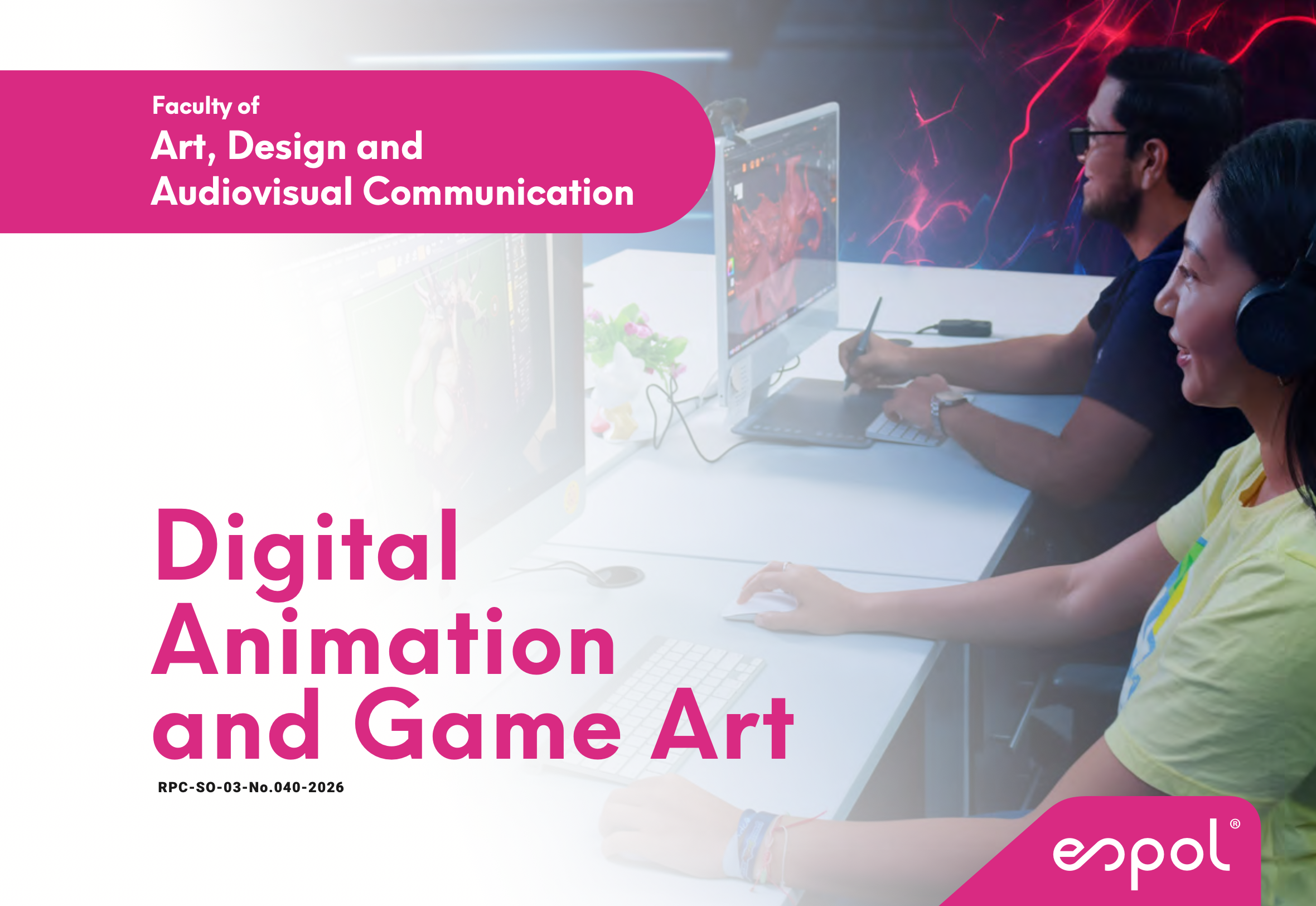
Graduates of the Digital Animation and Video Games degree programme are equipped to apply specialised methods, techniques and procedures in the development of artistic projects related to digital animation and video games, responding creatively and appropriately to the needs of the sector.
Their training enables them to manage animation projects for film and video games, as well as to analyse, design and implement innovative proposals based on social and cultural demand.
NOTE: This program is offered in a hybrid format. This means that the first few years will consist of in-person classes and exams, and as students progress through the curriculum, there will be a gradual decrease in in-person instruction and an increase in online or virtual learning.
Mission
To collaborate with society by training professionals of integrity, creativity and innovation in digital animation and video game production, equipped with research skills and critical thinking, who design high-impact visual solutions for the national and international industry, contributing to sustainable development.
Visión
To be a regional leader in the training of visual artists for animation and video games, spearheading innovation in the creation of high-impact visual solutions that drive human development and sustainability on a global scale.
* Undergraduate tuition/fees:
The Art. 356 of the Constitution of the Republic establishes, among other principles, that public higher education at the third level shall be free of charge, and that this gratuity is linked to the academic responsibility of the students.
We are looking for creative and resourceful students who wish to specialise in digital animation and video game art. To be eligible for this course, applicants must have:
-Keen sense of aesthetics.
-Visual literacy.
-Manual and technical skills.
-The ability to work independently.
-Motivation to develop digital animation and video game art products.
Technological Equipment Requirements for Students
To adequately participate in the program’s educational activities, students are required to have access to a computer capable of running applications for digital animation and game art, 3D modeling, 2D and 3D animation, Ray Tracing lighting, special effects, level design, and rendering, which will be used throughout the curriculum. The minimum technological equipment requirements are:
Recommended computer specifications for ADVI:
Windows 10 or later
Option 1.- Basic specifications:
- Latest-generation Intel Core i5 10th Gen or AMD Ryzen 5 processor (no more than 6 years old).
- 16 GB RAM or more, 512 GB SSD storage
- (GPU) NVIDIA RTX 3050 with 6 GB VRAM
- 15-inch monitor with 70–80% sRGB colour coverage
- USB-A, USB-C and Thunderbolt 3 ports
- internet connection via 10 Mbps Ethernet cable
- Wi-Fi 5 or higher.
- Peripherals: Keyboard, mouse, microphone, headphones, webcam and speakers.
- Additional equipment (basic): External hard drive, 512 GB storage. USB-C Thunderbolt 5 connection (10 Gbps) or higher.
Option 2.- Recommended specifications:
- Intel Core i7 12th Gen / Core Ultra 7 or AMD Ryzen 7 7000 / Ryzen 9 Zen 4 processor or higher (no more than 3 years old)
- 32 GB DDR5 RAM or higher; NVIDIA RTX 4060 graphics card (GPU) (8 GB VRAM) or higher
- 1 TB NVMe SSD storage or higher
- 15‘–16’ QHD (2560 × 1440 or higher) monitor with OLED or professional-grade IPS technology, with colour coverage: DCI-P3 ≥95% or 100% sRGB.
- Connectivity: Multiple USB-A ports, USB-C 10 Gbps, Thunderbolt 5, HDMI, Wi-Fi 6E or higher.
- High-performance cooling system.
- Webcam with Full HD (1080p) or HD (720p) resolution – 30 fps or higher
- Peripherals: keyboard, mouse. Closed-back headphones, designed for prolonged use. And a microphone with AI-powered noise cancellation and a cardioid polar pattern.
Additional equipment (preferred):
- 1 external monitor. 27-inch QHD OLED technology with 100% sRGB or higher (2560 × 1440 or higher).
- Recommended storage capacity: 1 TB or 2 TB. USB-C Thunderbolt 5 connection, 10 Gbps or higher. For backing up projects, renders and material libraries.
- Intuos graphics tablet, with Pro-3 pen. Alternatively, you can work with an 11-inch iPad with 256 GB of storage or higher, using the Apple Pencil.
NOTE: If students choose a Mac computer, they should be aware that some lighting and offline rendering features may be limited.
Software Requirements
The computer must be capable of running specialized software for design, modeling, animation, Ray Tracing lighting, special effects, level design, rendering, technical documentation, and project presentation, including:
- Unreal, Marmoset, Houdini, Side FX.
- Autodesk: Maya, 3ds Max, Arnold.
- Adobe Creative Cloud: Adobe Photoshop, Adobe Illustrator, Adobe Premiere, Adobe Substance, Adobe After Effects, Adobe Media Encoder, Adobe Acrobat PDF.
- Microsoft Office 365 or similar: Outlook, Word, Excel, PowerPoint.
FADCOM Technological Resources Available to Students
To support the development of the program’s competencies, students will have access to the technological resources available at the academic unit during regular working hours, from 8:00 a.m. to 4:00 p.m. These resources include physical laboratories equipped with workstations and the software required to conduct academic activities.
In addition, FADCOM provides a cloud-based laboratory with 30 virtual machines, available 24/7, including remote desktop environments with Office and Adobe licenses. To access these virtual machines, students must have a basic computer and an internet connection through an Ethernet network cable with a minimum speed of 10 Mbps. Access to the virtual machines will be managed through reservations and scheduled sessions according to demand and course workshop requirements.


Educational Objectives
To train professionals in the field of digital animation and video game production through the use of technological tools, the development of creative concepts and ideas, and strategic planning to design innovative visual solutions that meet the demands of national and international markets.
Graduates will excel as experts in art direction, animation production, video game design, virtual environments and worlds, animation scripts, 2D and 3D animation, rigging, character animation and special effects.
Competencies
1. Effective Communication
Communicate effectively orally and in writing with clarity and creativity in diverse contexts and perspectives.2. Learning Strategies
Apply learning strategies, managing information and digital content according to learning demands and communication uses.3. Value Propositions
Articulate value proposals from art, design, and communication, considering technical, economic, environmental, social, and cultural aspects.4. Research and Experimentation
Approach sociocultural, artistic, and historical objects of study, and conduct experimentation and research through qualitative and quantitative methodologies for knowledge generation and ethical management.5. Ethical Responsibility
Promote ethical responsibilities in professional issues and formulate informed judgments, considering the impact of solutions in social, environmental, economic, and global contexts.6. Teamwork
Function effectively as a proactive team member or leader, able to respect, understand, and evaluate work across various disciplines to achieve given goals.7. Professional English
The ability to communicate effectively with various audiences/diverse professional contexts in English.
Professional competencies
Competency 8
Demonstrate knowledge of animation principles and research, including visual, spatial, sonic, movement, and temporal elements, and how these elements are combined in the development of animation and game art.Competency 9
Apply concepts and processes for the development, coordination, and completion of animation and game art projects.Competency 10
Identify the characteristics and capabilities of various animation or game art methods and technologies within creative contexts.
First Year
Description:
This subject of basic training allows the understanding of the bases of technical drawing, the recognition of geometric shapes reaching basic geometry and the systems of dihedral and axonometric representation. The planes, their elements in projections and perspective are analyzed. Specific images are made of elements that signify and / or objectively communicate issues related to graphic design, audiovisual production and product design.
Description:
In this course, students apply the Design Thinking methodology to identify, analyze real-life problems or needs, to design innovative solutions. Students work in multidisciplinary teams to present solution proposals that add value to customers/users from private companies, public organizations and non-profit organizations.
Description:
This basic and general education subject presents grammatical structures to produce a simple paragraph based on a writing program. Additionally, it allows the identification of a specific argument in oral and written communication. It also considers learners’ personal opinions about different topics related to social, academic, and professional aspects. It includes the necessary vocabulary to make comparisons between present and past, books or movies description, creation of simple students’ profile, opinions about inventions, formal apologies and tell past events.
Description:
This is a basic subject which is part of the transversal axis of the Product Design, Graphic Design and Production for Media careers. It is a first year course in the curriculum and it is conceived as an introduction to mathematics, providing notions of elementary algebra, geometry and trigonometry in the study of the design, production and appreciation of artistic pieces. The main idea of the course is to promote in the student the development of skills that allow them to use techniques, methods and procedures of a mathematical nature in order to enrich their work in the field of art, design and audiovisual communication, for this the mathematical exercise not only in the operational and numerical aspect but also in the strengthening of geometric intuition.
Description:
This professional training course in the Media Production program establishes the fundamental concepts of audiovisual language, studying the basic principles that compose form and narrative style. Audiovisual works are analysed takingin to account the different points of view a narrator can have, the visual style, the sound resources, and their spatio-temporal conception.
Description:
The course presents students with strategies to solve common problems in various professional fields through the design and implementation of solutions based on the use of a programming language. It covers the basic principles so that the student can read and write programs; emphasizing the design and analysis of algorithms. In addition, it introduces students to the use of development and debugging tools.
Description:
This subject of basic formation and general education presents the grammatical structures for the production of an academic paragraph, through the development of the writing program in a transversal way. In addition, it allows the identification of specific arguments in oral and written communication, considering the production of one's own criteria on different topics of a social, academic or professional nature. The necessary vocabulary is also applied to refer to the different forms of communication, share work experiences and the use of digitl technology, tell short stories about interpersoanl relationship and personalities, and comment on the future of the environment.
Second Year
Description:
This professional training course of the Media Production career develops knowledge related to animated film: its history, language, uses and applications in the audiovisual field. Develops knowledge related to animated film: its history, language, uses and applications in the audiovisual field. It also studies the principles of animation as the basis of the technique. The course provides knowledge regarding processes, techniques and stages of an animated production through experimentation with analog and digital techniques. The skills acquired will be applied in the elaboration of a practical project.
Description:
This professional training course in the Media Production program addresses the expressive possibilities of the genres and formats used. The industry standards regarding structures, character construction, and conflict development for the creation of audiovisual narratives are explored.
Description:
This course is intended for undergraduate students in the early stages of their university education. It focuses on the analysis of effective interpersonal and group communication through practical workshops and interactive dynamics. Additionally, it strengthens student’s prosumer profiles by fostering complex, holistic, and critical thinking through the rigorous study of real-world contexts and academic/scientific readings. It also aims to improve the writing of technical and executive reports for diverse audiences by integrating digital and artificial intelligence tools to ethically optimize the production and revision of texts. In terms of oral expression, the course develops assertive communication techniques to enhance the dissemination of information and improve both verbal and nonverbal communication skills abilities that should be consolidated throughout student’s academic and professional lives.
Description:
The Statistics course provides students with the basic knowledge that will help them convert a data set into useful information for making decisions in scenarios of uncertainty. It encompasses different methods of tabulation and data analysis, the introduction of the concept of probability as a measure of uncertainty and mathematical models of discrete and continuous random variables. Additionally, analysis techniques such as regression and hypothesis testing of population parameters are included.
Description:
This subject of basic instruction and general education presents grammatical topics for the elaboration of an outline and a structured composition, through the development of the writing program in a transversal way. In addition, it allows the identification of arguments in oral and written communication on contemporary and academic topics. Additionally, appropriate vocabulary is applied to discuss issues related to different cultures, places where we live, everyday news, entertainment media, and past and future opportunities.
Description:
This course in the Communication Media Production program complements professional training in the field of 3D modeling and animation. It covers the history of 3D animation, general concepts, relevant characters, important milestones, as well as the creation of three-dimensional digital objects. It explores areas of modeling, texturing, and lighting of the scenes. Finally, the process of exporting to different formats for publication is analyzed.
Description:
This professional training course in the Media Production program develops practical theoretical knowledge about the history, evolution, processes, and elements of film editing. Additionally, criteria for structuring the audiovisual narrative are developed through working with its components. This course concludes with the review and application of practical processes within the discipline.
Description:
This professional training course in the Media Production program is oriented towards the in-depth study of the primary characteristics of sound and its interactions in acoustic environments through theoretical and practical exercises with all the necessary tools for basic audio recording and post-production that ensure quality standards, before and during the export process, thereby complementing the professional profile of a content creator for various audiovisual communication platforms.
Description:
This subject of basic formation and general education, presents the grammar structures to produce a persuasive essay, through the transversal development of the writing programme. In addition, it allows students to identify specific arguments in the oral and written communication, as well as, to express their own opinions about different topics of social, academic, or professional fields. It also includes the necessary vocabulary to stablish a conversation, narrate situations of their environment, activities to reach their goals, analyze cause and effect and personal and professional opportunities.
Third Year
Description:
This transversal course addresses the conditions required to innovate and the process associated with developing an innovation from an entrepreneurial point of view. Subsequently, topics such as the identification of opportunities, value creation, and prototyping and validation of products/services proposals are reviewed, as well as the elements of the business model and financial considerations that are essential for the feasibility and adoption of an innovation. Finally, entrepreneurial competences and process associated with the development and adoption of an innovation are studied.
Description:
This basic training and general education subject presents the necessary structures for the production of a persuasive essay, through the development of the writing program in a transversal way. It also allows the identification of specific arguments both in oral and written communication, in order to issue students' criteria on social, academic, or professional issues. They also apply the necessary vocabulary to engage in discussions about choices to make, changes in daily life and home, financial problems as well as moral dilemmas and achievements in the course of their personal, student, and professional lives.
Description:
This transversal training course for all students of the institution has five chapters. It introduces the key principles of sustainability and the path to sustainable development. Addresses ecological principles by deepen into biodiversity, ecosystems, human population and ecosystem services. Study the fundamentals of renewable and non-renewable resources as well as the alternatives for sustainable use. Analyzes environmental quality specifically in the air, water and soil components, delving into issues such as climate change, eutrophication and deforestation. Finally, it emphasizes on the economic axis with topics such as circular economy and on the social axis on topics such as governance and urban planning.
Description:
This vocal training subject addresses general research studies, from the philosophical and scientific point of view, and its application in the Design and Visual Communication area. It starts with an introduction to the research from its starting point concepts, types, and contexts. It continues with discussions around the resources and structure of research. Then addresses the different aspects of research methodologies and their approach to design. Finally, it focusses on the processes of data recollection, analysis, and discussion of results applied to practical research cases on selected topics under the paradigms “For - About - Through” the design. The selected themes are developed in stages from the first sessions of the subject until formalizing the presentation and discussion of its results in a documented manner.
Fourth Year
Additional
ARTS, SPORTS AND LANGUAGES ELECTIVE COURSES
1 credits - 1.9 ECTS
HUMANITIES ELECTIVE COURSES
1 credits - 1.9 ECTS
SELECTED ELECTIVE COURSE
3 credits - 5.8 ECTS
SELECTED ELECTIVE COURSE
3 credits - 5.8 ECTS
The graduate in Digital Animation and Video Games will be a highly skilled professional with advanced abilities in design, animation, and creative direction. They will be able to plan, implement, and evaluate projects, build innovative narratives, define creative strategies, and communicate effectively in an international environment.
- Animation and Video Game Producer.
- User Experience (UX) Designer, Interaction Designer.
- Creative Developer.
- Level/Mission/Character Prop Designer for Video Games.
- 3D Character Artist.
- 3D Environment Artist.
- 3D Modeler and Renderer.
- 2D, 3D, and 4D Effects Animator.
- Visual Effects (VFX) and Lighting Artist.
The following requirements must be met in order to obtain a Bachelor of Fine Arts in Digital Animation and Game Art:
| CATEGORY | CREDITS |
| Studio or Related Areas | 59 |
| Art studio, design theory | 12 |
| General Studies | 26 |
| Electives | 8 |
| Capstone project | 8 |
| Pre-professional practices | 7 |
| TOTAL | 120 |
Find out about the inclusive projects carried out by our students. Click here
DID YOU KNOW?
Students on the Digital Animation and Video Games course turn their creativity into characters, worlds and immersive experiences, using specialist tools for animation and video game development.